
Insights
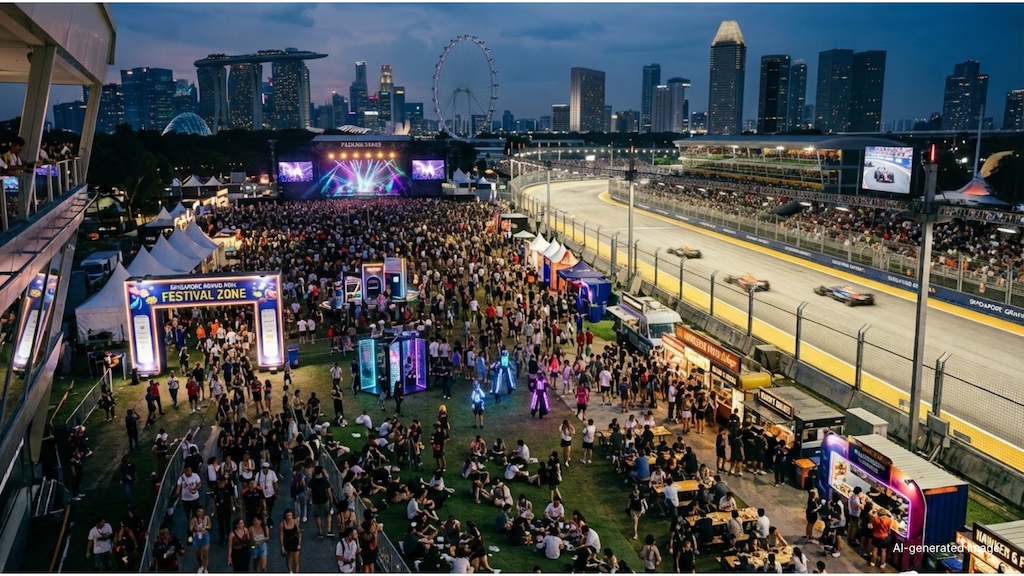
The Formula 1 Singapore Grand Prix sold out again in October 2026, drawing 301,294 spectators, the second-highest attendance in the race’s 17-edition history. That is around 650 more than the 300,641 who attended in 2025. The crowd has reached its ceiling. The growth now lives elsewhere.

301,294
Spectators
11
Hospitality offerings
60
Entertainment acts
The Formula 1 Singapore Grand Prix 2026 race set a new record for hospitality attendance across more than 11 hospitality offerings and added a floating Barge Stage to a race-day entertainment line-up featuring Lana Del Rey and Janet Jackson.
The lesson for any city competing for major events: once the grandstands are full, the value of a major sporting event is no longer captured inside the venue. It is spent around it, in the hospitality, the evenings, and the city that surrounds the competition.
“At the end of the day,sports fans who venture overseas are also travellers.”
Danielle Jin, Chief Marketing Officer, Visa Asia Pacific, speaking to TTG Asia
TTG Asia described festivalisation as “the carnivals and concerts that come with the actual sport”, noting that this layer is “just as influential” as the competition itself.
The spending profile supports it. Visa found that affluent travellers made up 30%of F1 Singapore visitors in 2025 but generated 40% of total traveller spending.This audience travels for a premium experience of a place, with the race as the reason to go now.
For tourism boards and rights holders, that changes the brief. The event is no longer a fixture that happens to take place in a city. It is a destination product, and the sport is its anchor tenant.
The Singapore Tourism Board has been clear about where the city’s advantage lies. Lilian Chee, STB’s Director, Sports, told TTG Asia that it begins with “world-class infrastructure and seamless operational excellence, from our venues and transport connectivity to the end-to-end experience of hosting major events.”
“Beyond the events, Singapore offers travelling fans something truly distinctive. As a compact, safe, and vibrant city, visitors can enjoy a world-class sporting event alongside everything else the destination has to offer.”
Lilian Chee, Director, Sports, Singapore Tourism Board, speaking to TTG Asia
STB’s stated ambition is for Singapore to become “Asia’s premier events capital”. Its method is telling. The Board “does not target specific sports”; it assesses which “genres, event formats, and concepts deliver the best tourism outcomes for Singapore.” The measure is the tourism outcome, not the sport.
Singapore is hosting at least nine top sporting events in 2026, and newer additions such as the Singapore Tennis Open, the NBA Rising Stars Invitational and the PGL Singapore Major 2026 extend the mix into new audiences, esports among them. Across the region, participation-led formats are scaling too: Hyrox’s August race in Bangkok drew more than 22,000 participants.
If the spend lives around the event, then the way an event is delivered determines how much of that spend a destination captures. Kin Global’s work on three of Singapore’s marquee events shows what that looks like on the ground.
The vantage point is part of the product. At the Formula 1 Singapore Grand Prix, Kin deploys circuit-wide viewing platforms and temporary marquees for operational teams. This is infrastructure built for one week inside a working city, shaping what spectators see and how the event runs behind the scenes. On a sold-out street circuit, where the crowd can no longer grow, the experience delivered to each visitor carries more of the weight, and the temporary build behind it has to hold.
The festival needs a partner who knows the ground. Kin is the official event partner for HSBC SVNS Singapore, one of the flagship legs of World Rugby’s international sevens series, and has delivered the Singapore leg since 2019. Rugby sevens has long been known as much for its festival atmosphere as for its matches. Continuity matters here: each edition compounds operational knowledge of the venue, the crowd and the city, which a destination cannot buy on a one-off contract.
Sport as culture, not only competition. FISE, the Festival International des Sports Extrêmes, made its Singapore debut in 2025, co-organised and co-promoted by Kin with Hurricane Group at *SCAPE and Somerset Skatepark. The format places urban sport inside a festival and in the heart of the city. With Visa data reported by TTG Asia showing 62% of Gen Z travellers in Asia-Pacific intend to travel for sports events, formats like FISE speak directly to the audience that will shape the next decade of event travel.


