
Insights
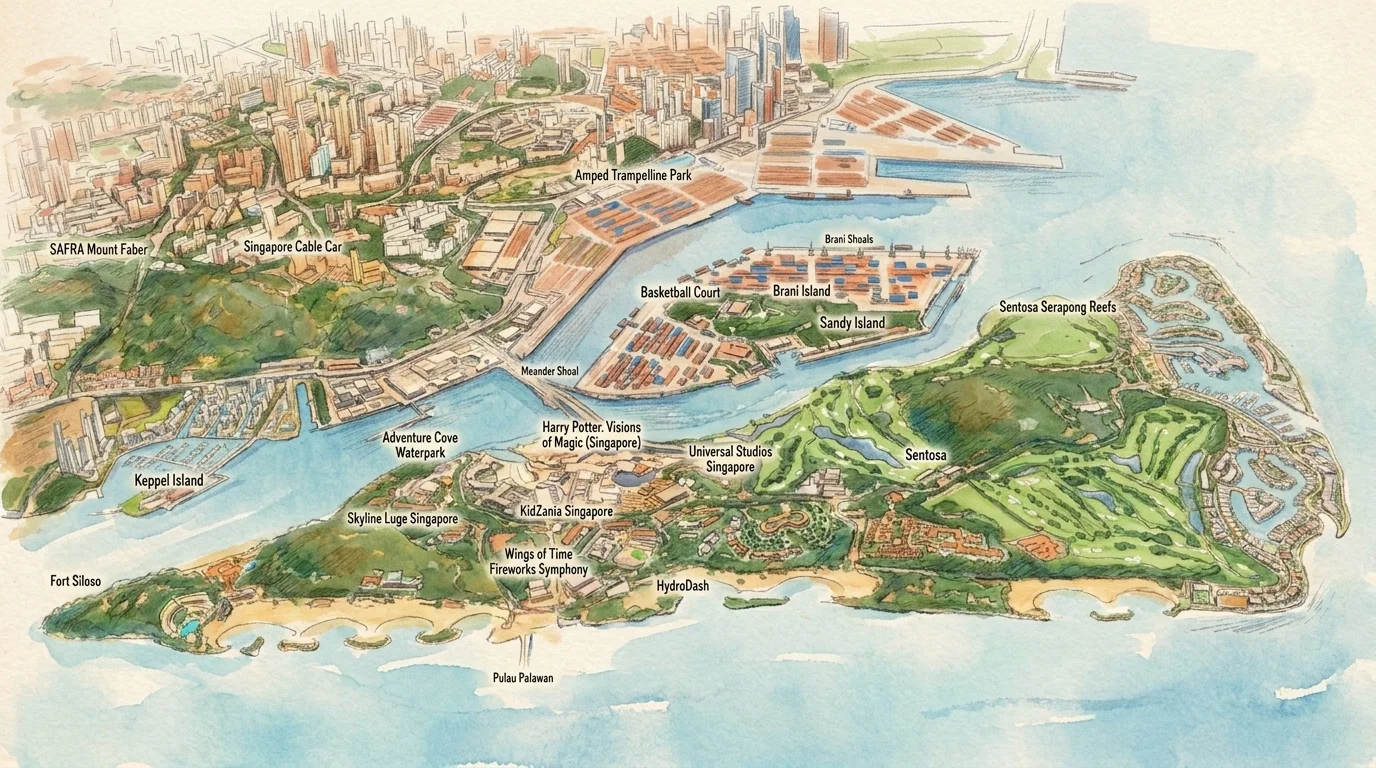
Sentosa is currently the site of two large, independently funded transformation programmes running in parallel — one public, one private. Genting Singapore is roughly 18 months into a US$5 billion (S$6.8 billion) overhaul of Resorts World Sentosa. Sentosa Development Corporation has just unveiled a 20-year Greater Sentosa Master Plan extending the island's footprint onto Pulau Brani.
Read separately, these are two property stories. Read together, they describe a single island being treated as Singapore's primary proving ground for large-scale visitor attractions — and a sustained, multi-year pipeline of design-and-build work behind both.

US$5B
RWS 2.0 expansion programme
700
more rooms in RWS expansion
88m
Light sculpture by Heatherwick Studio
120 ha
Pulau Brani included into plans
Lim Kok Thay, Executive Chairman and Acting CEO of Genting Singapore, confirmed in the company's 2025 Annual Report that the RWS 2.0 expansion is "progressing on schedule." The centrepiece is the Waterfront Lifestyle Development, which broke ground in November 2024 and is scheduled for completion in 2030: two new luxury hotels adding 700 rooms, a four-storey retail and dining podium, an experiential mountain trail, and a waterfront promenade. At its heart will stand an 88-metre light sculpture developed in collaboration with Heatherwick Studio — the internationally renowned design and architecture practice — intended, in Lim's words, as "a breathtaking centrepiece and must-visit attraction."
The Singapore Oceanarium — a three-times-larger reimagining of the former S.E.A. Aquarium, spanning 22 zones — reopened on 23 July 2025 as part of the same $6.8 billion expansion programme. At its launch, Singapore Tourism Board chief executive Melissa Ow called it a "significant milestone" in Singapore's Tourism 2040 roadmap, while Minister Grace Fu noted it would "strengthen [Singapore's] appeal to both local and international visitors with refreshed and immersive experiences." Genting Singapore's own reporting frames the wider expansion — which also includes Minion Land at Universal Studios Singapore and the Weave retail complex — as designed to "enhance Singapore's position as a must-visit destination."
Commercially, the timing matters: Genting Singapore's Adjusted EBITDA fell 17% year-on-year in FY2025 to S$815.8 million, a decline the company has directly attributed to disruption from the ongoing enhancement works. That is a useful data point for anyone assessing this sector — major attraction overhauls carry real, board-reported short-term costs, and operators are choosing to absorb them anyway because the long-term destination-positioning case outweighs the near-term drag.
Three months after RWS 2.0's Oceanarium milestone, SDC unveiled the Greater Sentosa Master Plan — a 20-year plan bringing the 120-hectare Pulau Brani into Sentosa's development footprint, alongside new icons including the Sensorium (a beachfront venue for indoor lifestyle attractions) and the Imbiah Canopy (attractions, F&B and heritage-trail infrastructure atop Mount Imbiah). SDC has projected roughly double the island's current visitor numbers once the plan matures, and named Brani West specifically as one of its largest sites for attractions development — with partner engagements for that site already underway.
Where RWS 2.0 is a single operator reinvesting in its own integrated resort, GSMP is a land authority actively sourcing external design-and-build partners for new sites. The two plans are unconnected in ownership and governance, but they are geographically adjacent and temporally overlapping: RWS's Waterfront Lifestyle Development completes in 2030, the same window SDC has flagged for GSMP's first new attractions to open.
Two independently capitalised programmes committing billions of dollars to attraction infrastructure on the same small island, in the same decade, is not a coincidence worth treating lightly. It is a market signal: Singapore's tourism strategy is placing a specific, concentrated bet on Sentosa as the site where the next generation of the country's must-visit attractions gets built.
For organisations in the museum, gallery, and themed-attraction design-and-build space, that concentration is the opportunity — it means sustained, overlapping demand for concept development, fabrication, and installation capability on a single island, rather than isolated one-off projects scattered across the city.
It also raises the bar. Heatherwick Studio's involvement in RWS 2.0's centrepiece light sculpture sets a design benchmark that GSMP's own attractions — the Sensorium, the Imbiah Canopy — will implicitly be measured against. Partners entering the Brani West conversation are not just building attractions; they're building attractions that will sit, geographically and reputationally, beside a Heatherwick-designed icon.
Kin's Design & Build division (Kin d+b) has already delivered inside these exact constraints, on this exact island. The High Dive Tower, built for the World Aquatics Championships Singapore 2025, was Southeast Asia's first structure of its kind — 37 metres, completed in under three months. Fast, technically demanding builds on constrained Sentosa sites are not a hypothetical capability for Kin; they are a demonstrated one, delivered in the same environment SDC and Genting Singapore are now both investing billions to develop further.
The heritage and museum-attraction side of that capability is equally demonstrated, off-island. Singapore Odyssea, Kin's redevelopment of the National Museum of Singapore's Shaw Foundation Glass Rotunda, opened on 8 August 2025 as the museum's SG60 gift to the nation — a 700-year immersive journey through Singapore's history built around a 2.5-metre spherical LED globe and an RFID-enabled personalisation system, delivered over a 16-month redevelopment window. It is the same category of work — heritage storytelling translated into a permanent, technology-driven visitor experience — that SDC's Imbiah Canopy and heritage-trail plans will require.
Kin also has a direct delivery track record inside Resorts World Sentosa itself. As the Event Delivery Partner for the FIDE World Chess Championship 2024, held in the Equarius Hotel ballroom at RWS, Kin managed the full venue build — including acoustic field-of-play construction rated to STC40 and a one-way mirror spectator system — within a 36-hour setup window, for a championship carrying a US$2.5 million prize fund and global broadcast coverage. That project sits under Kin's event delivery capability rather than Design & Build, but it establishes something the design-and-build case alone cannot: Kin has already worked to RWS's own operational standards, inside an RWS venue, under exactly the kind of compressed timeline that both RWS 2.0 and GSMP will continue to demand.


