
Insights
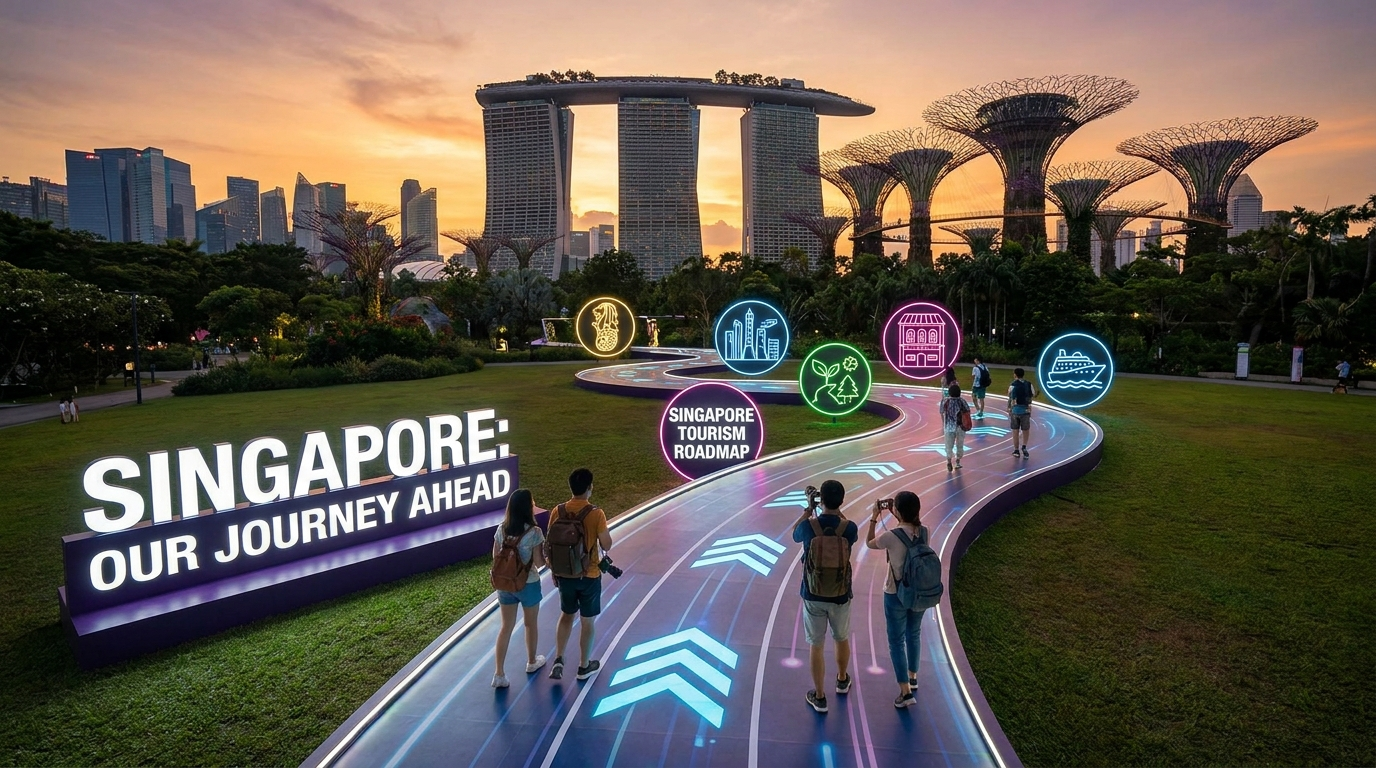
The Singapore Tourism Board's Tourism 2040 roadmap, unveiled at the Tourism Industry Conference (TIC) 2025 and reinforced at TIC 2026, sets a target that demands attention: tourism receipts of between SGD 47 billion and SGD 50 billion by 2040 — 1.7 times the SGD 29.8 billion recorded in 2024. In 2025, receipts climbed further to a record SGD 32.8 billion, a 10% increase year-on-year, confirming that the trajectory is real and that the policy framework is already bearing results.

$32.8B
Singapore tourism receipts, full-year 2025 (record)
$47–50B
STB Tourism 2040 target for tourism receipts
3 times
STB target to triple MICE tourism receipts by 2040
$740M
New Tourism Development Fund committed, 2026–2031
The Singapore Tourism Board's Tourism 2040 roadmap, unveiled at the Tourism Industry Conference (TIC) 2025 and reinforced at TIC 2026, sets a target that demands attention: tourism receipts of betweenSGD 47 billion and SGD 50 billion by 2040 — 1.7 times the SGD 29.8 billion recorded in 2024. In 2025, receipts climbed further to a record SGD 32.8 billion, a 10% increase year-on-year, confirming that the trajectory is real and that the policy framework is already bearing results.
STB Chief Executive Melissa Ow, speaking atTIC 2026, was direct about what drives this ambition: "It sets out how we will respond to rising global competition, shifting demographics, and emerging opportunities, to reach our goal of SGD 47 to SGD 50 billion in tourism receipts by 2040." (SingaporeTourism Board / TTRWeekly, May 2026). The roadmap rests on three pillars — cultivating demand, enhancing destination attractiveness, and developing a future-ready tourism sector. Each of these pillars has a direct line to events.
For event organisers, the significance is not merely that Singapore has set a large number. It is that the government has explicitly identified events — sporting, cultural, MICE, and live entertainment— as the primary engine of reaching it.
The clearest signal in the Tourism 2040 framework for event professionals is the MICE ambition. STB aims to triple MICE tourism receipts by 2040 and grow the sector's share of total tourism receipts from 4% to 10% (STBTourism 2040 Factsheet, 2025; TTGAsia, April 2025). The rationale is economic: on average, a MICE visitor spends twice as much as a leisure visitor (SingaporeMinistry of Trade and Industry, April 2025).
The global MICE market is itself growing. Singapore's MICE market size is estimated at USD 4.8 billion in 2025 and is projected to reach USD 8.89 billion by 2032, growing at a CAGR of 9.2% (Coherent Market Insights, as cited by Focus on Travel News, April 2025). Singapore, as Asia-Pacific's top meeting city, is well-positioned to capture a disproportionate share of that growth — but only with the right event delivery infrastructure and capability in place.
To realise this ambition, STB has already secured a pipeline of anchor MICE events. The Passenger Terminal Expo Asia 2026 will bring over 3,500 aviation leaders to Singapore. SIBOS 2027, one of the largest financial sector conferences globally, will attract 7,000 delegates. InnoTrans Asia, the Asian edition of the world's leading transport technology trade fair, launches in Singapore in 2027. The Milken Institute Asia Summit has made a three-year commitment to anchor in Singapore from 2026 (Singapore Ministry of Trade and Industry, April 2025; The ASEAN Magazine, January 2026).
STB has highlighted the development of a new downtown MICE hub — a dedicated large-scale facility that would leverage Singapore's existing venue ecosystem, hotels, and lifestyle infrastructure to compete for the world's largest conventions and exhibitions (STB Tourism 2040 Factsheet, 2025). If delivered, this hub would make Singapore the most formidable MICE destination in the Asia-Pacific by a significant margin.
For event organisers and rights holders evaluating Asia as a base, the message is unambiguous: Singapore's government is not simply facilitating MICE — it is underwriting it.
Tourism 2040's second pillar is the strengthening of Singapore's destination appeal through compelling tourism products and experiences — and events sit at the core of this pillar. The record 2025 tourism performance makes the evidence plain. Sight-seeing, entertainment, and gaming spending each grew 15% year-on-year in the first three quarters of 2025, driven significantly by live events including the Formula 1 Singapore Grand Prix and major international concerts (SingaporeTourism Board, February 2026; Travel and Tour World, March 2026).
The concert economics that defined 2024 —when the Eras Tour and Coldplay's Music of the Spheres concerts were credited with attracting tens of thousands of international visitors, with the Monetary Authority of Singapore noting that half of each concert's audience came from overseas — established a precedent that STB has formalised into strategy. Events are now a distinct and deliberate demand-generation instrument, not an opportunistic add-on to Singapore's tourism offer.
STB's partnership with Klook, investing over SGD 2 million in digital marketing to promote events as tourism drivers, is one marker of this shift (Travel and Tour World, March 2026). Another is the government's explicit inclusion of leisure events alongside MICE as a contributor to destination attractiveness in all public Tourism 2040 communications. Cruise tourism, wellness experiences, and new attractions at Sentosa and the Changi East Urban District are all being developed as part of an integrated experience ecosystem that surrounds and enhances event visits.
One element of Tourism 2040 that carries particular significance for event organisers is the Changi Airport Terminal 5 development. The new terminal, expected to open in the mid-2030s, will increase Singapore's airport passenger capacity from 90 million to 140 million annually (CNBC,April 2025). Transit and transfer passengers currently account for one-third of Changi's overall traffic — and converting a portion of this segment into stopover tourists visiting for events is an explicit objective of the Tourism 2040 demand strategy.
The practical implication for event professionals is significant: a 55% increase in airport capacity, aligned with a deliberate government campaign to convert transit passengers into event visitors, represents a structural expansion of Singapore's accessible event audience. Events that fill stadiums today will be able to draw from a far wider international catchment by the time Terminal 5 opens.
STB's 'The Singapore Lounge' campaign, launched with Changi Airport Group and Singapore Airlines in January 2025, was an early expression of this strategy — positioning Singapore as the ideal stopover destination for short-form event experiences. For event organisers programming one to three-day experiences, this is a material shift in the visitor funnel.


